The Demo That Lied
This is Part 1 of the Harness Engineering series - a deep dive into the production infrastructure layer that sits between your LLM and your users. This article covers the architecture. Parts 2-8 go deep on each layer.
This series grew into a book: Harness Engineering for Production AI Systems. What is inside is at the end of this article.
You've shipped "production-ready" LLM features before. You know the feeling.
The playground worked perfectly. You tested 20 edge cases, the model handled all of them. You showed the demo to stakeholders, it was flawless. You deployed.
And then - at 2am on a Tuesday - your on-call phone fires. The agent is stuck in a loop. It's been apologizing for "the confusion" for 47 minutes, burning tokens on every retry, and your users are getting back nothing but a spinner.
You dig into the logs. The model returned a valid-looking response. But it wrapped a number in quotes. One field. One wrong type. And your downstream system - which trusted the model completely - fell over.
Here's what nobody told you when you started building with LLMs: the model worked fine. Your system didn't.
That's the gap this article is about. Not prompt engineering. Not model selection. The layer between the LLM and your production system - the layer most teams skip entirely - that's where real AI reliability is built or broken.
I call it Harness Engineering.
What Harness Engineering Actually Is
Most teams treat the LLM as the system. They spend weeks perfecting prompts, evaluating models, and benchmarking output quality. Then they wire the model directly to their application code and ship.
This is the wrong mental model.
An LLM is not a reliable software component. It's a probabilistic engine - volatile, stateful in unexpected ways, and capable of producing output that is syntactically valid but semantically broken. You wouldn't wire raw mains voltage directly into your laptop. You'd use a converter, a regulator, a fuse. The harness is exactly that - a deterministic wrapper around a probabilistic engine.
Harness Engineering is the discipline of designing that wrapper. Not talking to the model better. Containing the model so it cannot break your system, regardless of what it outputs.
The goal is not to make the model smarter. The goal is to reduce the space in which it can be wrong.
Prompt engineering is local optimization. You tune the inputs and hope the output cooperates — or measure whether the tuning actually helped instead of hoping. Harness engineering is systems design. You assume the output will eventually break your assumptions - and you build for that.
Harness vs. Framework: A Critical Distinction
Before going further, one confusion worth clearing up - because your audience will have it.
A framework is not a harness.
LangChain, LangGraph, CrewAI, AutoGen - these are frameworks. They give you components: agent loops, tool abstractions, prompt templates, memory interfaces. They're blueprints and building materials. You use them to assemble an agent architecture.
A Harness Architecture is the runtime environment that governs how that agent executes in production. It manages what context the model sees, enforces which tools it can call, validates what it outputs, gates what it acts on, checkpoints state, and handles failure. The harness is the factory floor where the blueprint becomes a running, reliable system.
You can build a framework-based agent without a harness. Teams do it constantly. It's why agents that demo well fail in production - the framework got them to a working prototype, but the harness that makes it survive real users was never built.
| Framework | Harness | |
|---|---|---|
| What it is | Build-time components | Runtime execution environment |
| Purpose | Assemble agent architecture | Govern agent behavior in production |
| Examples | LangChain, LangGraph, CrewAI | Your validation layer, gate, repair loop |
| When it matters | Design and implementation | Deployment and operations |
| Without it | Can't build the agent | Can't ship the agent |
The relationship is complementary. Use a framework to build. Build a harness to ship. Most teams are excellent at the first part and skip the second entirely.
Why Prompt Engineering Hits a Wall in LLM Orchestration
Prompt engineering assumes that if you phrase things clearly enough, the model will behave. I call this Linguistic Optimism - and it doesn't scale to production.
Here's the specific failure mode: prompts are brittle at the edges. The center of your input distribution? The model handles it beautifully. The edges - unusual user phrasing, unexpected input length, missing fields, multilingual inputs, adversarial content - that's where prompt-only systems crack. Intent classification is a textbook case for this failure mode - a confident label on a paraphrase the model never saw in training.
And in production, edge cases aren't edge cases anymore. They're just users.
Consider the difference:
| Dimension | Prompt Engineering | Harness Engineering |
|---|---|---|
| Philosophy | Tell the model what to do | Build a system where it can't do wrong |
| Failure mode | Silent failure / hallucination | Caught exception / controlled retry |
| Predictability | Probabilistic | Deterministic at the system level |
| Scalability | Degrades at the edges | Holds at scale |
| Debuggability | "Why did it say that?" | Structured logs, clear failure paths |
The shift in mental model is this: a good prompt makes a demo work. A good harness makes a product survive.
The Seven Layers of a Production Harness
A production harness isn't a single module. It's a layered execution pipeline - each layer absorbing a specific failure mode before it propagates downstream.
This layered system is what I call a Harness Architecture. The diagram below is its core execution loop - the mental model for everything that follows:
graph TD
    A[User Request] --> B[Layer 1: Normalization]
    B --> C[Layer 2: Context Orchestration]
    C --> J[Layer 3: Constraint Layer]
    J --> D[LLM Reasoning]
    D -- Provider Fail --> K[Layer 6: Circuit Breaker]
    K --> D
    D -- Long-running --> I[Layer 7: State Management]
    I --> D
    D --> E[Layer 5: Validator / Guardrails]
    E -- Failure --> F[Repair Loop]
    F --> D
    E -- Success --> G[Layer 4: Gated Execution]
    G --> H[Final Output]

    style A fill:#4A90E2,color:#fff
    style B fill:#7B68EE,color:#fff
    style C fill:#9B59B6,color:#fff
    style J fill:#9B59B6,color:#fff
    style D fill:#FFD93D,color:#000
    style K fill:#E74C3C,color:#fff
    style I fill:#FFA07A,color:#fff
    style E fill:#6BCF7F,color:#fff
    style F fill:#E74C3C,color:#fff
    style G fill:#98D8C8,color:#000
    style H fill:#4A90E2,color:#fff
This diagram represents the core execution loop of a production Harness Architecture - all seven layers. Every node exists because a real production system failed without it. Note the two red nodes: the Repair Loop (exception path when model output fails validation) and the Circuit Breaker (exception path when the LLM provider itself fails). Both are recovery branches. Both are non-optional. Let's go through each layer at the level of what actually breaks when you skip it.
Layer 1: The Normalization Layer
This is the first thing the request touches before the model sees it.
Normalization does two things: it strips input noise and it enforces prompt consistency. Input noise is everything that shouldn't reach the model - trailing whitespace, OCR artifacts, HTML entities, user-injected role overrides ("Ignore all previous instructions..."), metadata from UI components that the user didn't intend to send.
Without normalization, your prompt becomes a surface area. Every unexpected character is a potential exploit or a reasoning failure.
What breaks without it: prompt injections, confused reasoning caused by UI metadata, inconsistent behavior across different client surfaces (mobile sends the request differently than desktop, and the model behaves differently because of it).
What it looks like in practice: a preprocessing function that runs before context assembly. Sanitize. Truncate. Validate field presence. Detect injection patterns. Normalize whitespace. Only then pass to the next layer.
Normalization patterns, prompt injection defense, and multi-surface input consistency will be covered in full in Part 2 of this series.
Layer 2: Context Orchestration
This is the layer most teams get wrong even when they know it exists.
Context orchestration is not "put everything in the prompt."
It's assembling exactly the right context for the current task - no more, no less.
The "Lost in the Middle" problem is real. LLMs perform worse on content buried in long contexts. Dump 40 RAG chunks into the prompt, and the model reasons well on the first few and the last few - and poorly on everything between.
That's not a model failure. That's a context design failure.
Context orchestration means: retrieve, filter, rank, compress, assemble. Budget your context window the way you budget compute.
Without this layer: you're paying for tokens the model ignores, while the tokens that matter get buried.
I'll do a full deep dive into Context Engineering - memory architectures, retrieval strategies, context compression - in Part 3 of this series.
Layer 3: The Constraint Layer
The model can only do what you permit it to do. The constraint layer enforces that.
In agentic systems, this is where action scope is defined. What tools can the model call? What APIs are in scope? What can it read? What can it write?
Without explicit constraints, you get hallucinated actions - the model tries to call an API that doesn't exist, references a UI element it invented, or takes an action that was never in scope. This isn't rare. In any sufficiently complex tool-calling setup, it happens.
Concretely: your tool registry, your action schema, your permission model. The model sees only what you expose. Nothing else is reachable, regardless of what the model thinks it can do.
Without this layer: the model's imagination becomes your attack surface.
We'll get into deterministic constraint design - tool registries, action manifests, scope enforcement - in Part 8 of this series.
Layer 4: Gated Execution
The validator tells you the output is structurally correct. Gated execution decides whether to actually run it.
The model proposes. The gate decides. That's the whole principle.
This is the firewall between model intent and real-world side effects. LLM output - even valid, schema-compliant output - can carry parameters that are dangerous to execute. A deletion query with a WHERE clause that matches everything. An API call with a dollar amount of -$10,000. A SQL statement that's syntactically valid but semantically destructive.
Gated execution adds a semantic check before any action with side effects runs. High-risk actions escalate to a human approval step. Lower-risk actions run automated policy checks.
In practice this looks like: a policy engine that evaluates proposed actions against a ruleset before dispatch. Budget guards. Rate limiters. Dry-run modes that preview side effects before committing. Human-in-the-loop escalation paths for irreversible actions.
Without this layer: structurally valid output causes real-world damage. The model didn't hallucinate. The system just didn't check before it acted.
Policy engine design, human-in-the-loop escalation patterns, and budget guards for agentic systems will be covered in Part 4 of this series.
Layer 5: The Validation and Repair Layer
This is the layer that makes the difference between a flaky demo and a production system.
The model will produce malformed output. Not occasionally - regularly. Especially under load, with unusual inputs, or when the prompt has drifted from what the model was fine-tuned on. The validation layer catches this before it reaches your application code.
At minimum: schema validation. Is the JSON well-formed? Are required fields present? Are types correct? Does the structure match what downstream expects?
But good validation goes further:
Semantic validation - does the content make sense given the task?
Range validation - are numeric values in plausible bounds?
Consistency validation - do interdependent fields agree with each other?
When validation fails, you have two options: fail fast, or repair. Fail fast is appropriate when the failure is unrecoverable or when retrying is expensive. Repair loops are appropriate when the failure is deterministic and correctable - send the error back to the model with the schema violation explicitly stated and ask it to try again.
In practice, most teams implement this with Pydantic for schema definition and validation, and Instructor (built on top of Pydantic) for structured LLM output that automatically retries on validation failure. These are the industry-standard tools for this layer - if you're hand-rolling JSON parsing without them, you're doing it the hard way.
Here's the pattern in plain Python to show what's happening under the hood:
def validated_call(prompt: str, schema: dict, max_retries: int = 3) -> dict: for attempt in range(max_retries): raw = llm.call(prompt) try: result = parse_and_validate(raw, schema) return result except ValidationError as e: if attempt == max_retries - 1: raise prompt = build_repair_prompt(prompt, raw, e) # unreachable, but explicit raise MaxRetriesExceeded()The model doesn't need to be perfect. It needs to be correctable. That's a much lower bar - and the harness is what makes it achievable.
I'll cover advanced Validation Layer design - including semantic validators, repair prompt patterns, and when to fail fast vs. retry - in Part 5 of this series.
Layer 6: Graceful Degradation
The model goes down. Rate limits hit. Latency spikes to 30 seconds. Your third-party LLM provider has an incident.
Graceful degradation is how your system behaves when the probabilistic engine is unavailable or unreliable.
Without this layer, a model outage becomes a system outage. Your users get a 500 error with a stack trace. Your application is completely non-functional until the model recovers.
With graceful degradation, you have: circuit breakers that stop hammering a degraded endpoint, fallback models that step in at reduced capability, cached responses for common queries, and user-facing messaging that's honest about reduced functionality without being alarming.
The pattern is familiar from distributed systems. LLMs just need it applied explicitly, because most teams don't think of the model as an external dependency that can fail - they think of it as the application itself.
Retry strategies, fallback model selection, and circuit breaker patterns for LLM systems will be the focus of Part 6 of this series.
Layer 7: State Management
This layer only becomes visible when your agents start running for more than a few seconds. Which, in production, they will.
A simple request-response LLM call has no state problem. But an agentic workflow - one that runs 20 steps, calls multiple tools, processes intermediate results, and might take 5 minutes to complete - is a long-running process. And long-running processes fail mid-execution.
What breaks without it: the agent crashes at step 14 of 20. Without state management, it restarts from step 1. Your user waits another 5 minutes. Worse, some of those first 14 steps had side effects - files written, APIs called, records updated. Now you're replaying them. Duplicate records. Double-charged transactions. Corrupted state.
State management gives the harness checkpoint-resume capability. At each meaningful step, the harness serializes current state - what has been done, what the intermediate results are, what still needs to happen. If the agent fails or the process dies, it resumes from the last checkpoint, not from scratch.
It also covers cross-session memory for agents that span multiple interactions. When a user picks up a task tomorrow that they started today, what does the agent remember? How is prior context structured and compressed so the next session doesn't start blind?
In practice this looks like: checkpointing state to a durable store (Redis, Postgres, or a purpose-built agent memory layer) after each tool call or reasoning step. Structured scratchpad files the agent maintains itself. Summarization of prior steps before injecting into the next session's context.
Without this layer: every long-running agentic task is a gamble. You're betting the process completes before something goes wrong. At production scale, that bet loses constantly.
State management architectures for long-running agents - including checkpoint strategies, memory compression, and cross-session context design - will be covered in depth in Part 7 of this series.
A Full Harness in Action
Let's make this concrete. A user submits a 50-page contract: "Summarize this and extract all liability risks."
Without a harness, you dump the contract into the prompt, call the model, and pray the output JSON is parseable.
With a Harness Architecture, every layer has a job:
Normalization: Strip OCR artifacts. Detect the document type and jurisdiction. Clean encoding issues. Identify that this is a legal document, not a general query - route accordingly.
Context Orchestration: Don't send the full 50 pages. Use a chunked retrieval strategy - pull only the sections semantically close to "liability," "indemnification," "limitation of damages," and "termination." Compress boilerplate. Assemble a focused context under the token budget.
Constraint Layer: The task is extraction only. The model is not permitted to call external APIs, modify any records, or take any write actions. The action scope is read-only, output-only.
LLM Call (Structured Output): Instruct the model to return a JSON array conforming to a specific schema: [{clause: string, risk_type: string, severity: "low" | "medium" | "high", damage_cap: number | null}].
Validation: Parse the response. Check that damage_cap is a number, not a string like "$500,000". Check that severity is one of the allowed enum values. Check that no required fields are missing.
Repair Loop: The model returned "damage_cap": "$500,000" - a string. The validator catches it. The harness sends back: "Validation error: field 'damage_cap' must be a number (e.g., 500000), not a currency string. Please retry." The model corrects on the next attempt.
Gated Execution: This is a read-only extraction task, so no gate check needed. For a task that would write to a database, this is where the policy check runs.
Final Output: A validated, schema-compliant JSON object, ready for the downstream system. Zero manual intervention. Zero crashes. The model made a mistake and the harness absorbed it.
That's Harness Engineering working as designed.
The Reliability Math
Here's the framing that changes how you think about this:
Your LLM might be 85% accurate on your task. That means roughly 1 in 7 calls produces output that is wrong or malformed in some way. At 10 calls/second, that's over 129,000 failures per day. Without a harness, each of those is a user-facing failure.
Now make it agentic. Say each step in your multi-step pipeline succeeds 95% of the time - which sounds solid. Chain 20 steps together, and your end-to-end task completion rate drops to 36%. This is the compounding failure problem. The math predicts agents that appear reliable at the step level will fail on roughly a third of real end-to-end tasks. That gap between "it works" and "it ships" is exactly what the harness closes.
Two different failure modes. Same root cause: no harness.
With a harness - specifically with validation, repair loops, and state management - a large fraction of those failures become self-correcting. The model is wrong at step 14, the harness catches it, repairs or retries, and the user sees nothing. Your system reliability can be 99%+ even with an 85% accurate model underneath.
This is engineering. Not hoping the model performs better. Building a system that absorbs model failures and maintains reliability guarantees despite them.
The metric that matters is not model accuracy. It's system reliability. And system reliability is a property of the harness, not the model.
A good prompt makes a demo work. A good harness makes a product survive.
The Discipline Shift: From Prompt Whispering to Systems Engineering
The industry is making a transition right now, and most teams are behind it.
Early LLM adoption was dominated by prompt engineers - people who were skilled at getting good outputs from models through careful instruction. This skill is real and it matters. But it's not sufficient for production systems.
Production LLM systems need AI systems engineers - people who think in terms of failure modes, reliability guarantees, fallback behavior, observability, and system-level correctness. People who instrument their harness, not just their prompts.
The metrics change. You stop tracking ROUGE scores and start tracking:
- Validation failure rate - what fraction of model outputs fail schema checks?
- Repair loop success rate - of those failures, how many does the harness self-correct?
- Circuit breaker trip count - how often is the model endpoint degraded enough to trigger fallback?
These are harness metrics. They're how you know whether your system is reliable, independent of how "smart" the model is.
LLMs don't fail gracefully. Systems must.
The mental shift is from "how do I make the model do the right thing" to "how do I build a system that produces the right outcome even when the model does the wrong thing."
These are not the same question. The second one is harder. It's also the one that matters in production.
What to Build First in Your Agentic Workflow
If you're starting from a system with no harness, don't try to build all seven layers at once. Build in this order:
First: Validation. If you're doing structured output today with no schema validation, you have a reliability bomb. Add it now. It takes hours and immediately eliminates the most common failure mode.
Second: The Repair Loop. Wire your validator to send structured error messages back to the model. This alone will recover a significant fraction of your failures without any human intervention.
Third: Normalization. Clean your inputs before they hit the model. Especially if you're taking user input from the web - sanitize for injection patterns and normalize encoding.
Fourth: Gated Execution. If your system has any write operations triggered by model output, add a policy gate before execution. This is non-negotiable for any agentic system.
Fifth: Graceful Degradation. Add fallback behavior and circuit breakers. Your LLM provider will have an incident eventually. How does your system behave when that happens?
Sixth: State Management. Once your agents run for more than a few seconds, add checkpointing. This only becomes critical when you go agentic - but when it matters, it matters immediately.
Seventh: Context Orchestration. Optimize once the basic reliability mechanisms are in place. Don't over-engineer your context pipeline before you've fixed your validation.
The Containment Principle
LLMs are not software components in the traditional sense. They are volatile, high-energy systems that produce probabilistic outputs. In every other engineering domain, volatile components are not trusted - they are contained. The containment layer is what makes the system predictable.
The harness is that containment layer.
You don't ship prompts. You ship systems that survive bad prompts. The model is the least reliable component in your stack - and good systems engineers don't trust their least reliable component. They design around it.
The model gets the credit when the demo works. The harness is the reason the product is still running.
What's Next in This Series
This article introduced the architecture. The next articles go deep on each layer:
- Part 2: Normalization and Input Defense - Prompt injection patterns, input sanitization, multi-surface consistency, and defending against input variance at scale
- Part 3: Context Engineering - Memory architectures, retrieval strategies, context compression, and the "Lost in the Middle" problem in depth
- Part 4: Gated Execution - Policy engines, human-in-the-loop design, dry-run patterns, and budget guards for agentic systems with real-world side effects
- Part 5: Validation Layer Design - Schema validators, semantic checks, repair prompt patterns, and when to fail fast vs. recover
- Part 6: Retry, Fallback, and Circuit Breaking - Building resilient LLM infrastructure that survives model outages and latency spikes
- Part 7: State Management for Agentic Systems - Checkpoint-resume strategies, cross-session memory, and durable state for long-running agents
- Part 8: Deterministic Constraint Systems - Building tool registries and action manifests that prevent hallucinated actions in agentic systems
What is inside Harness Engineering for Production AI Systems
This series grew into a book. The seven layers above are all in it, organised around one question: is this component a sensor that observes, a comparator that checks against a standard, a gate that decides whether a proposal becomes an action, or a bound that caps how far the system can go? A component that is none of the four is application code.
Explore the book: harness.ranjankumar.in
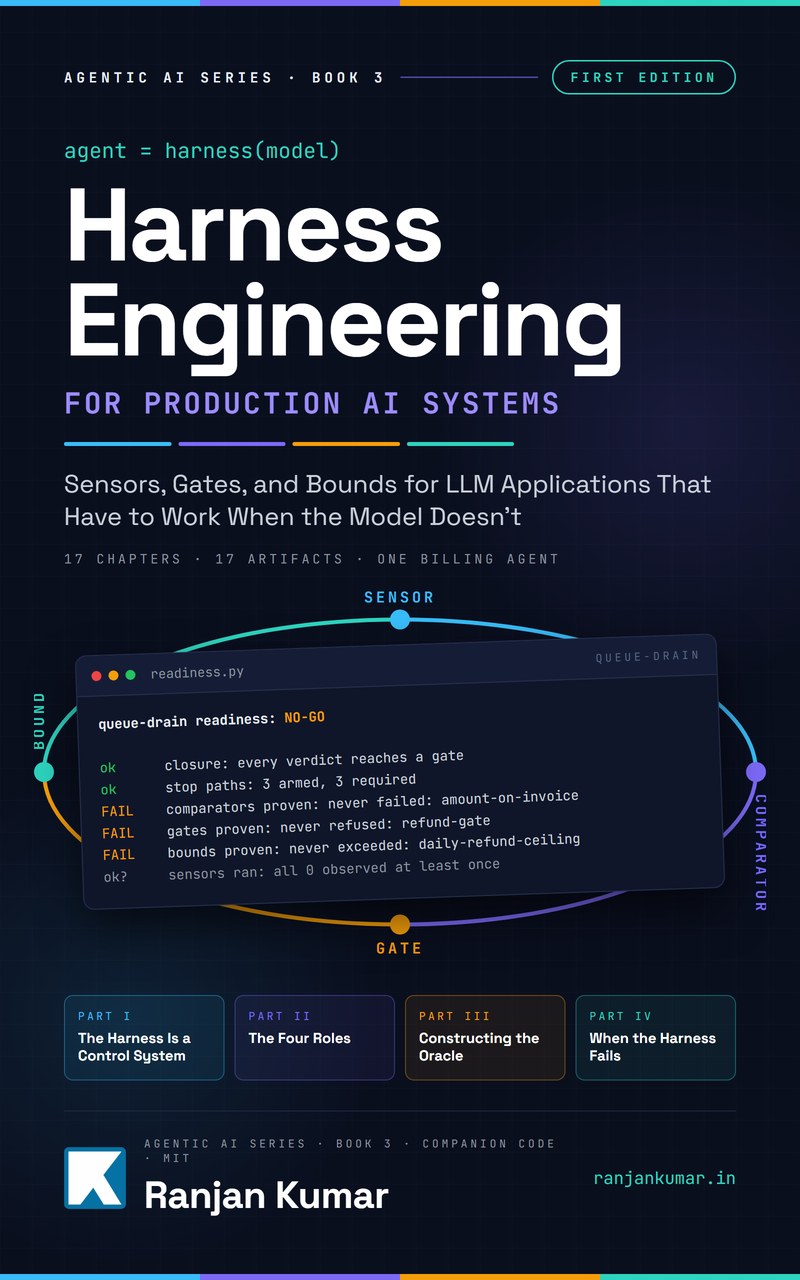
One running example carries the whole book: a billing support agent that reads tickets, looks up invoices, applies credits, and issues refunds, with a human reviewing every reply by day and nobody there overnight. Its refund tool moves money and has no undo, which is what makes the gate design concrete.
Part I - The Harness Is a Control System. The demo cliff, the trust boundary, and the four roles.
Part II - The Four Roles. Input defence, context assembly, signals, validation and repair, resilience, gated execution, deterministic constraints, checkpoints, ceilings, and authority bands. Parts 2 to 8 of this series each became one of these chapters.
Part III - Constructing the Oracle. Testing the harness with no model and with a hostile one, and attributing a failure to the model, the harness, or their interaction.
Part IV - When the Harness Fails. Failure modes of the control layer itself.
Every numbered chapter ships one artifact you can copy into a repository, and every control appears as a plain Python object, as the artifact it reads, and as the LangGraph node that wires it in. The companion code is on GitHub under the MIT License, and its tests run with no API key, no network, and no model: harness-engineering-code.
References
-
Liu, N. F., Lin, K., Hewitt, J., et al. (2023). Lost in the Middle: How Language Models Use Long Contexts. Transactions of the Association for Computational Linguistics, 12, 157-173. https://doi.org/10.1162/tacl_a_00638
-
Ouyang, L., Wu, J., Jiang, X., et al. (2022). Training language models to follow instructions with human feedback. arXiv:2203.02155. https://arxiv.org/abs/2203.02155
-
Shinn, N., Cassano, F., Labash, B., et al. (2023). Reflexion: Language Agents with Verbal Reinforcement Learning. arXiv:2303.11366. https://arxiv.org/abs/2303.11366
-
Yao, S., Zhao, J., Yu, D., et al. (2023). ReAct: Synergizing Reasoning and Acting in Language Models. ICLR 2023. https://arxiv.org/abs/2210.03629
-
Chase, H. (2022). LangChain: Building applications with LLMs through composability. https://github.com/langchain-ai/langchain
-
Liu, J. (2023). Instructor: Structured outputs for LLMs. https://github.com/instructor-ai/instructor
-
Fowler, M. (2018). Circuit Breaker. martinfowler.com. https://martinfowler.com/bliki/CircuitBreaker.html
-
Chen, S. (2026). The Complete Guide to Agent Harness: What It Is and Why It Matters. harness-engineering.ai. https://harness-engineering.ai/blog/agent-harness-complete-guide/
-
Kumar, R. (2026). Harness Engineering for Production AI Systems. Part I, "The Harness Is a Control System" (Chapters 1-3). https://harness.ranjankumar.in/
Related Articles
- Normalization and Input Defense: Hardening the Entry Point of Your LLM System
- Validation Layer Design: Building the Reflex That Catches What the Model Gets Wrong
- Retry, Fallback, and Circuit Breaking: Building LLM Infrastructure That Survives Outages
- Context Engineering: What the Model Sees Is What the Model Does


