In modern AI pipelines, provenance — the lineage of datasets, models, and inferences — is becoming as important as accuracy metrics. Regulators, auditors, and even downstream consumers increasingly demand answers to questions like:
-
Which dataset was this model trained on?
-
What code commit produced this artifact?
-
How do we know logs weren’t tampered with after training?
To learn more about provenance in AI, read my previous article: Provenance in AI: Why It Matters for AI Engineers - Part 1
To answer the above-raised questions, let’s walk through a Python-based provenance tracker that logs lineage events, cryptographically signs them, and maintains schema versioning for forward compatibility.
1. The Provenance Tracker: Key Features
The ProvenanceTracker implements three important ideas:
-
Multiple dataset support
-
Models often train on more than one dataset (train + validation + test).
-
This tracker keeps a list of dataset hashes (
dataset_hashes) and auto-links them to model logs.
-
-
Signed JSONL envelopes
-
Each log entry is wrapped in an envelope:
{ "schema_version": "1.1", "signed_data": "{…}", "signature": "" } -
signed_datais serialized with stable JSON (sort_keys=True). -
A digital signature (RSA + PSS padding + SHA-256) is generated using a private key.
-
-
Schema versioning
schema_version = "1.1"is embedded in every record.
2. The Provenance Tracker: Source Code
Before we get to the provenance tracker code, let's see a companion script generate_keys.py that creates the RSA keypair (private_key.pem, public_key.pem). This is used by the ProvenanceTracker.py to sign the JSONL logs.
# generate_keys.pyfrom cryptography.hazmat.primitives.asymmetric import rsafrom cryptography.hazmat.primitives import serialization# Generate RSA private key (2048 bits)private_key = rsa.generate_private_key( public_exponent=65537, key_size=2048,)# Save private key (PEM)with open("private_key.pem", "wb") as f: f.write( private_key.private_bytes( encoding=serialization.Encoding.PEM, format=serialization.PrivateFormat.PKCS8, encryption_algorithm=serialization.NoEncryption(), ) )# Save public key (PEM)public_key = private_key.public_key()with open("public_key.pem", "wb") as f: f.write( public_key.public_bytes( encoding=serialization.Encoding.PEM, format=serialization.PublicFormat.SubjectPublicKeyInfo, ) )print("✅ RSA keypair generated: private_key.pem & public_key.pem")Run once to create your keypair:
python generate_keys.py
Here’s a secure ProvenanceTracker (schema version 1.1) that:
-
Supports multiple datasets
-
Includes schema version
-
Signs JSONL using RSA private key
# ProvenanceTracker.pyimport hashlibimport jsonimport osimport platformimport socketimport subprocessimport base64from datetime import datetimefrom typing import Any, Dict, Listfrom cryptography.hazmat.primitives import hashes, serializationfrom cryptography.hazmat.primitives.asymmetric import paddingclass ProvenanceTracker: SCHEMA_VERSION = "1.1" def __init__(self, storage_path: str = "provenance_logs.jsonl", private_key_path: str = "private_key.pem"): self.storage_path = storage_path self._dataset_hashes: List[str] = [] # track datasets used self.private_key = self._load_private_key(private_key_path) def _load_private_key(self, path: str): with open(path, "rb") as f: return serialization.load_pem_private_key(f.read(), password=None) def _get_git_commit(self) -> str: try: return subprocess.check_output( ["git", "rev-parse", "HEAD"], stderr=subprocess.DEVNULL ).decode("utf-8").strip() except Exception: return "N/A" def _hash_file(self, file_path: str) -> str: h = hashlib.sha256() with open(file_path, "rb") as f: while chunk := f.read(8192): h.update(chunk) return h.hexdigest() def _sign(self, payload: str) -> str: signature = self.private_key.sign( payload.encode("utf-8"), padding.PSS( mgf=padding.MGF1(hashes.SHA256()), salt_length=padding.PSS.MAX_LENGTH, ), hashes.SHA256(), ) return base64.b64encode(signature).decode("utf-8") def _log(self, record: Dict[str, Any]): record["timestamp"] = datetime.utcnow().isoformat() record["schema_version"] = self.SCHEMA_VERSION # Serialize signed_data separately (stable JSON encoding) signed_data = json.dumps(record, sort_keys=True) signature = self._sign(signed_data) envelope = { "schema_version": self.SCHEMA_VERSION, "signed_data": signed_data, "signature": signature, } with open(self.storage_path, "a") as f: f.write(json.dumps(envelope) + "\n") def log_dataset(self, dataset_path: str, description: str = ""): dataset_hash = self._hash_file(dataset_path) self._dataset_hashes.append(dataset_hash) record = { "type": "dataset", "path": dataset_path, "hash": dataset_hash, "description": description, } self._log(record) return dataset_hash def log_model(self, model_name: str, hyperparams: Dict[str, Any]): record = { "type": "model", "model_name": model_name, "hyperparameters": hyperparams, "git_commit": self._get_git_commit(), "environment": { "python_version": platform.python_version(), "platform": platform.system(), "hostname": socket.gethostname(), }, "dataset_hashes": self._dataset_hashes, # link all datasets } self._log(record) def log_inference(self, model_name: str, input_data: Any, output_data: Any): record = { "type": "inference", "id": f"inf-{hashlib.sha1(json.dumps(input_data).encode()).hexdigest()[:12]}", # deterministic ID "model_name": model_name, "input": input_data, "output": output_data, } self._log(record)if __name__ == "__main__": tracker = ProvenanceTracker() # 1. Log datasets ds1 = tracker.log_dataset("data/training.csv", "Customer churn dataset") ds2 = tracker.log_dataset("data/validation.csv", "Validation set") # 2. Log model (linked to all datasets seen so far) tracker.log_model("churn-predictor-v2", { "algorithm": "XGBoost", "n_estimators": 200, "max_depth": 12, }) # 3. Log inference tracker.log_inference( "churn-predictor-v2", {"customer_id": 54321, "features": [0.4, 1.7, 0.2]}, {"churn_risk": 0.42} ) print("✅ Signed provenance logs recorded in provenance_logs.jsonl")3. Under the Hood
3.1 Datasets
Datasets are logged with a SHA-256 file hash, ensuring that even if file names change, the integrity check remains stable.
ds1 = tracker.log_dataset("data/training.csv", "Customer churn dataset")ds2 = tracker.log_dataset("data/validation.csv", "Validation set")Resulting record (inside signed_data):
{ "type": "dataset", "path": "data/training.csv", "hash": "a41be7b96f...", "description": "Customer churn dataset", "timestamp": "2025-08-28T10:12:34.123456", "schema_version": "1.1"}3.2 Models
When logging a model, the tracker attaches:
-
Model metadata (name, hyperparameters)
-
Git commit hash (if available)
-
Runtime environment (Python version, OS, hostname)
-
All dataset hashes seen so far
tracker.log_model("churn-predictor-v2", { "algorithm": "XGBoost", "n_estimators": 200, "max_depth": 12,})This creates a strong lineage link:
Dataset(s) → Model
3.3 Inferences
Every inference is logged with a deterministic ID, computed as a SHA-1 hash of the input payload. This ensures repeat queries generate the same inference ID (helpful for deduplication).
tracker.log_inference( "churn-predictor-v2", {"customer_id": 54321, "features": [0.4, 1.7, 0.2]}, {"churn_risk": 0.42})Graphically:
Model → Inference
4. Signed Envelopes for Tamper-Proofing
Each record is not stored raw but wrapped in a signed envelope:
{ "schema_version": "1.1", "signed_data": "{\"description\": \"Validation set\", \"hash\": \"c62...\"}", "signature": "MEUCIQDgtd...xyz..."}To verify:
-
Load the public key.
-
Verify the
signatureagainst the serializedsigned_data. -
If modified, verification fails → tampering detected.
This is exactly the mechanism PKI systems and blockchain protocols use for immutability.
5. Example End-to-End Run
When running ProvenanceTracker.py:
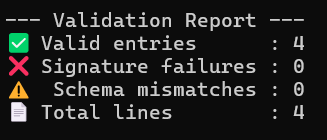
$ python ProvenanceTracker.py✅ Signed provenance logs recorded in provenance_logs.jsonlThe log file (provenance_logs.jsonl) will contain three signed envelopes — one each for datasets, the model, and an inference.
Following is provenance_logs.jsonl after run:
{"schema_version": "1.1", "signed_data": "{\"description\": \"Customer churn dataset\", \"hash\": \"a41be7b96fb85110521bf03d1530879e9ca94b9f5de19866757f6d184300fff7\", \"path\": \"data/training.csv\", \"schema_version\": \"1.1\", \"timestamp\": \"2025-08-28T01:06:31.062695\", \"type\": \"dataset\"}", "signature": "MnCRJ+Acg0F1UledjnMwQMp24wAIPmLPaZonI7hvdFvdi7d8CaZDOIamNq0KnRgcZgttJnI1L675tqT1O1M5N2FRNuy/Wj6elzpyM9w56Kd2mBcQLFumhVHiGZHtwKj2wQtXND0SCqWo5jxQPLPl0dSFClA+FKzpxfazwMtrHAE7aoUmyt2cv1Wiv9uZxsE+Il226J91rBk03lpLcArqqxTtfstkayOK5AON9ETXs65ERf26oURngR/0HS9jnO0IH1DxZOcHcfWZMrLwGqdjRF1sSDYcH70XV61yeYzSeIb8KDODttuxxfzsIlb0897tv/ZZ/X4tv/FFICei7LeAuw=="}{"schema_version": "1.1", "signed_data": "{\"description\": \"Validation set\", \"hash\": \"330af932f2dc1cae917f3bd0fb29395c4021319dd906189b7dc257d0ad58a617\", \"path\": \"data/validation.csv\", \"schema_version\": \"1.1\", \"timestamp\": \"2025-08-28T01:06:31.070827\", \"type\": \"dataset\"}", "signature": "pu8IvzPriN6eP9HTQGlIog8nfXV0FOEw818aw6uJS8oPKiQPjN3odzbP9zaeB+ZW4Nu9bBL5fm1btiiOSm9ziWUJWUzFRoHwlYTv2rgp/IXR0oWfTpXsdVeBj7NYVjUywLPofTeEE1C4J7XzZmusuCU9ZiKJzXU442E6Gsrj6tjRJxZoylONuekxegdTot4LwIcmCRtgigi1t3rQYBGdknmTFdW/I2h1Gguh+Shc/WG/jVuMq10vFNNM8iUJJAxAEktbpfhGw0of6lrZu9yn4wAmxvq0DFICKMEJlsyvEZ/mDaPkR4D55xuJh+dLlFbzNZvyw0woMII0hbIarNmG+w=="}{"schema_version": "1.1", "signed_data": "{\"dataset_hashes\": [\"a41be7b96fb85110521bf03d1530879e9ca94b9f5de19866757f6d184300fff7\", \"330af932f2dc1cae917f3bd0fb29395c4021319dd906189b7dc257d0ad58a617\"], \"environment\": {\"hostname\": \"GlamorPC\", \"platform\": \"Windows\", \"python_version\": \"3.10.11\"}, \"git_commit\": \"N/A\", \"hyperparameters\": {\"algorithm\": \"XGBoost\", \"max_depth\": 12, \"n_estimators\": 200}, \"model_name\": \"churn-predictor-v2\", \"schema_version\": \"1.1\", \"timestamp\": \"2025-08-28T01:06:31.117627\", \"type\": \"model\"}", "signature": "tq/y6Blz04u2iYZh5OqfyZChADA+osNIzwb9Z2g++AZjFu2hkywazf19rbTMsdx9J5s4BDz6rglfcFczRW/TXMECD3k91ZmAds/e0I+Xw42xeTnr7+jHKq5kPdV6Pan8yFVd9ikGso93ZDatX72rx+orIg41BggFN7ifYlKNnGD87zCypahI7Eev0frnD6w8GybmPcBMnCVLYlIo2nWpLgJELkVpwwagQ9rKA+WOlBbLe41ZizooSL/hhGJOXTuwYrkJpBZ69TIwCzihINr+joZBqYrPF+0E+CFohdc03b0SFv1OuNTo7dyqL9qpWdCMSi1iK0LfCukCO41Bvr2yHA=="}{"schema_version": "1.1", "signed_data": "{\"id\": \"inf-0276b2064ad0\", \"input\": {\"customer_id\": 54321, \"features\": [0.4, 1.7, 0.2]}, \"model_name\": \"churn-predictor-v2\", \"output\": {\"churn_risk\": 0.42}, \"schema_version\": \"1.1\", \"timestamp\": \"2025-08-28T01:06:31.118634\", \"type\": \"inference\"}", "signature": "Lf9r1vcXOaCxSc11UKNvuDjx7FophWXBxAobYlixIJgNIk2toFtEdjB2zzJtQI5cYEAImhNHB8hdssKUv3Dths0SpKeMQjpb0x0aKvXolnNsJMnEnGP443IRfMTpkcHpRjCVjIfEvP8EtAh58z4yHE77cy2IlSUFu3exwSEcRFVqBXvIKlojQTEneERUwEDZjfniluomSCLXiVFYMIB+LefPHGkChCVVulmyFJ9ITquD4Wymp2/c2/knopqXSP00EFON4SBOD9/RyQAXAl5UxP0s6faD7NeZxAdJWh3CY31+5V3Vv8b9y/jroAvxWjbpuCZT20gkHemArawDae3s0w=="}The following is the standalone verification code validate_logs.py:
#!/usr/bin/env python3"""Usage: python validate_logs.py provenance_logs.jsonl public_key.pem"""import jsonimport base64import sysfrom cryptography.hazmat.primitives import hashesfrom cryptography.hazmat.primitives.asymmetric import paddingfrom cryptography.hazmat.primitives.serialization import load_pem_public_keyEXPECTED_SCHEMA = "1.1"def load_public_key(path: str): with open(path, "rb") as f: return load_pem_public_key(f.read())def verify_signature(public_key, signed_data: str, signature_b64: str) -> bool: try: signature = base64.b64decode(signature_b64) public_key.verify( signature, signed_data.encode("utf-8"), padding.PSS( mgf=padding.MGF1(hashes.SHA256()), salt_length=padding.PSS.MAX_LENGTH, ), hashes.SHA256(), ) return True except Exception: return Falsedef validate_file(jsonl_path: str, pubkey_path: str): public_key = load_public_key(pubkey_path) valid_count = 0 failed_count = 0 schema_mismatch = 0 with open(jsonl_path, "r") as f: for line_no, line in enumerate(f, start=1): try: envelope = json.loads(line.strip()) except json.JSONDecodeError: print(f"❌ Line {line_no}: invalid JSON") failed_count += 1 continue schema = envelope.get("schema_version") signed_data = envelope.get("signed_data") signature = envelope.get("signature") if schema != EXPECTED_SCHEMA: print(f"⚠️ Line {line_no}: schema version mismatch ({schema})") schema_mismatch += 1 continue if not signed_data or not signature: print(f"❌ Line {line_no}: missing signed_data/signature") failed_count += 1 continue if verify_signature(public_key, signed_data, signature): valid_count += 1 else: print(f"❌ Line {line_no}: signature verification failed") failed_count += 1 print("\n--- Validation Report ---") print(f"✅ Valid entries : {valid_count}") print(f"❌ Signature failures : {failed_count}") print(f"⚠️ Schema mismatches : {schema_mismatch}") print(f"📄 Total lines : {valid_count + failed_count + schema_mismatch}")if __name__ == "__main__": if len(sys.argv) != 3: print("Usage: python validate_logs.py provenance_logs.jsonl public_key.pem") sys.exit(1) jsonl_file = sys.argv[1] pubkey_file = sys.argv[2] validate_file(jsonl_file, pubkey_file)Output:
6. Extending This for Real-World AI Workflows
An AI engineer could extend this design in several directions:
-
Neo4j Importer: Build a provenance graph to visualize dataset → model → inference lineage.
-
Metrics integration: Log evaluation metrics (
AUC,F1) into the model record. -
MLOps pipelines: Integrate into training jobs so every experiment auto-generates signed lineage logs.
-
Cloud KMS keys: Replace PEM private key with keys from AWS KMS, GCP KMS, or HashiCorp Vault.
-
Verification service: Deploy a microservice that validates provenance logs on ingestion.
7. Why This Matters for You
As AI systems leave the lab and enter regulated domains (finance, healthcare, insurance), being able to say:
- “This prediction came from Model X at commit Y, trained on Dataset Z, verified cryptographically.”
…will be non-negotiable.
Implementing provenance today sets you ahead of compliance requirements tomorrow, and ahead of the provenance debt that accrues every time model output enters an asset you own unrecorded.
This ProvenanceTracker is a blueprint for trustworthy AI engineering — versioned, signed, and reproducible lineage for every dataset, model, and inference in your pipeline. What it cannot do is travel with the output once the text leaves your pipeline; that calls for watermarking the text itself, rather than logging its lineage.
Note: The Customer churn dataset can be downloaded from Kaggle and can be renamed and placed in the data directory.
Related Articles
- Provenance in AI: Auto-Capturing Provenance with MLflow and W3C PROV-O in PyTorch Pipelines – Part 4
Follow for more technical deep dives on AI/ML systems, production engineering, and building real-world applications:


