Think about how you use the internet today. You Google something, or you ask ChatGPT. You scroll through Twitter or Instagram. You read the news on your phone. Simple, right?
But something big is changing. The internet is splitting into three different worlds. They'll all exist on your phone, but they'll be completely different experiences. And most people won't even know which one they're using.
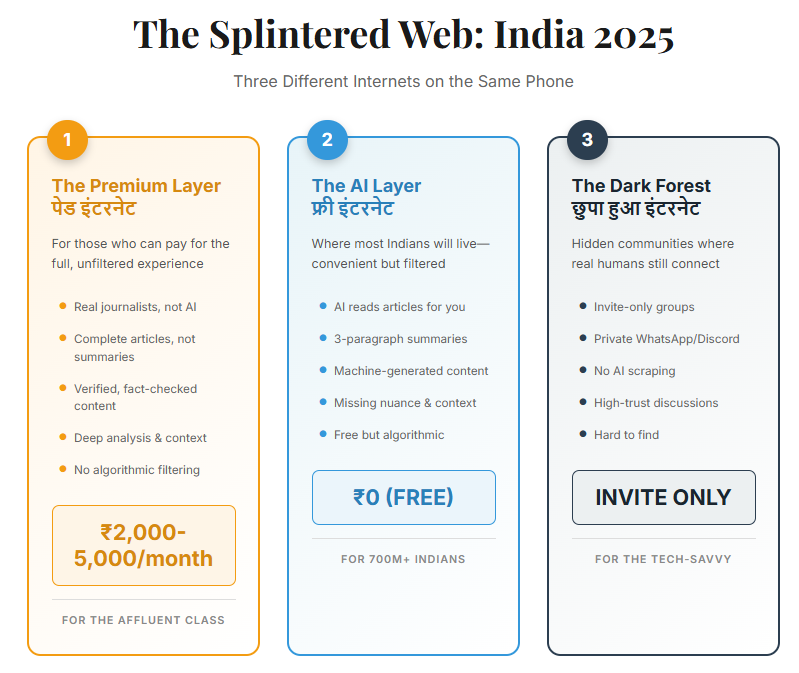
Layer 1: The Premium Internet (Only for Those Who Can Pay)
Imagine The Hindu or Indian Express, but they charge you ₹5,000 per month. Why so much? Because they promise that no AI has touched their content. Every article is written by real journalists, edited by real editors, and meant to be read completely—not just summarized by ChatGPT.
This isn't just about paywalls. It's about the full experience. Like reading a well-written book versus reading chapter summaries on Wikipedia. You pay for the writing style, the depth, and the way the story is told.
Think about this: A Bloomberg Terminal costs lakhs per year. Why? Because traders need real, unfiltered information. Now imagine that becoming normal for all good content.
Here's the problem for India: If quality information becomes expensive, only the rich get the full story. Everyone else gets summaries, shortcuts, and AI-filtered versions. This isn't just unfair—it's dangerous for democracy.
Layer 2: The AI Internet (Where Bots Read for You)
This is where most Indians will spend their time. It's free, but there's a catch.
You don't read articles anymore—your AI does. You ask ChatGPT or Google's Bard: "What happened in the Parliament session today?" The AI reads 50 news articles and gives you a 3-paragraph summary.
Sounds convenient, right? But think about what you're missing:
-
The reporter's perspective and context
-
The details that didn't fit the summary
-
The minority opinions that the AI filtered out
-
The emotional weight of the story
Now add another problem: Most content will be written by AI, too. AI writing for AI readers. News websites will generate hundreds of articles daily because that's what gets picked up by ChatGPT and Google.
Think about how WhatsApp forwards spread misinformation in India. Now imagine that happening at an internet scale, with AI systems copying from each other. One wrong fact gets repeated by 10 AI systems, and suddenly it becomes "truth" because everyone agrees.
Layer 3: The Dark Forest (Where Real People Hide)
This is the most interesting part. When the internet becomes full of AI-generated content and surveillance, real human conversation goes underground.
This is like how crypto communities use private Discord servers. Or how some journalists now share real stories only in closed WhatsApp groups.
These spaces are
-
Invite-only (you need to know someone to get in)
-
Hard to find (no Google search will show them)
-
High-trust (everyone vouches for everyone else)
-
Small and slow (quality over quantity)
Here's what happens in these hidden spaces: Real discussions. People actually listening to each other. Long conversations over days and weeks. Experts sharing knowledge freely. Communities solving problems together.
But there's a big problem: to stay hidden from AI and algorithms, you have to stay hidden from everyone. Great ideas get trapped in small circles. The smartest people become the hardest to find.
Why This Matters for India
India has 750 million internet users. Most are on free platforms—YouTube, Instagram, WhatsApp. Very few pay for premium content.
So what happens when the internet splits?
Rich Indians will pay for premium content. They'll read full articles, get complete context, and make informed decisions.
Middle-class and poor Indians will use AI summaries. They'll get the quick version, filtered by algorithms, missing important details.
Tech-savvy Indians will find the dark forest communities. But most people won't even know these exist.
This creates a new kind of digital divide. Not about who has internet access, but about who has access to real information.
The Election Problem
Imagine the 2029 elections. Different people are getting their news from different layers:
Premium readers get in-depth analysis
AI layer users get simplified summaries (maybe biased, maybe incomplete)
Dark forest people get unfiltered discussions, but only within their small groups
How do we have a fair election when people aren't even seeing the same information? When does fact-checking happen in different layers?
The Education Problem
Students from rich families will pay for premium learning resources. Clear explanations, quality content, and verified information.
Students from middle-class families will use free AI tools. They'll get answers, but not always the full understanding. Copy-paste education.
The gap between haves and have-nots becomes a gap between those who understand deeply and those who only know summaries.
Can We Stop This?
Maybe, if we act now. Here's what could help:
Government-funded quality content: Like Doordarshan once provided free TV, we need free, high-quality internet content. Not AI-generated. Real journalism, real education, accessible to everyone.
AI transparency rules: AI should show its sources. When ChatGPT gives you a summary, you should see which articles it read and what it left out.
Digital literacy programs: People need to understand which layer they're using and what its limits are. Like how we teach people to spot fake news on WhatsApp, we need to teach them about AI filtering.
Public internet infrastructure: Community spaces that aren't controlled by big tech. Like public libraries, but for the internet age.
But honestly? The market doesn't want this. Premium content companies want to charge more. AI companies want to collect more data. Tech platforms want to keep people in their ecosystem.
What You Can Do Right Now
While we can't stop the internet from splitting, we can be smart about it:
-
Read actual articles sometimes, not just summaries. Your brain works differently when you read the full story.
-
Pay for at least one good news source if you can afford it. Support real journalism.
-
When using AI, ask for sources. Don't just trust the summary.
-
Join or create small, trusted communities. WhatsApp groups with real discussions, not just forwards.
-
Teach your kids to think critically. To question summaries. To seek original sources.
The Bottom Line
The internet is changing fast. In a few years, we'll have three different internets:
-
The expensive one with real content
-
The free one where AI does your reading
-
The hidden one where real people connect
Most Indians will end up in the middle layer—the AI layer. Getting quick answers, but missing the full picture. This isn't just about technology. It's about who gets to know the truth. Who gets to make informed decisions? Who gets to participate fully in democracy?
We need to talk about this now, while we still have a common internet to have this conversation on.
The question is not whether the internet will split. It's already happening. The question is: Will we let it create a new class divide in India, or will we fight to keep quality information accessible to everyone?
Which internet are you using right now? Do you even know?
Related Articles
- Building Agents That Remember: State Management in Multi-Agent AI Systems
- Building Production-Ready Agentic AI: The Infrastructure Nobody Talks About
- ChatML: What It Is, Why OpenAI Removed It, What Replaced It
- Choosing the Right LLM Inference Framework: A Practical Guide
Follow for more technical deep dives on AI/ML systems, production engineering, and building real-world applications:


